
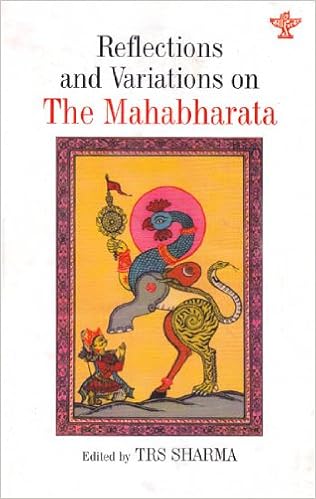
The book is based on the papers read during the International seminar on the Mahabharata: tests, Contexts, readings held by Sahitya Akademi, New Delhi as parts of its Golden Jubilee celebrations. The book contains 24 essays and articles The Mahabharata is described as a leviathan of an epic which is three times the size of Iliad and Odyssey put together. The epic is not treated as history but as a literary work which contains various complementary and contradictory elements. The epic in its first stage of growth called ‘Jaya’ contained some 8000 or so verses and its second stage expanded to 24,000 stanzas. The third stage it grew into what we now have with nearly 100,000 stanzas. The book also explores how, Siva, Rama and Krishna have become not only Indian cultural icons but are also part of the Hindu collective imagination. Various rewritings of the epic in various Indian languages are also discussed. The re-readings of the epic in Bengali was done by Buddhadev Bose with his well-known version known as ‘Mahabharater Katha’. The two novelists in Malayalam who tried to re-write the epic are P.K Balakrishnan and M.T Vasudevan Nair. There are also essays/articles about the Konkani version and Kannada version of the epic. In Marathi, one prominent work of interpretation is ‘Astika’ by Sane Guruji. In Hindi, the play by Dharmavir Bharati titled Andha Yug presents a modern version of the epic. The Kannada novel ‘Parva’ by S.L. Bhyrappa, and ‘Grandmother’s Desires’ by Kumudini (Real Name: Ranganayaki Thatam) are also mentioned in the book.

No comments:
Post a Comment