Tuesday, 9 September 2025

Remembering Leo Tolstoy


Reading an excerpt of War and Peace to commemorate the birth anniversary of Leo Tolstoy 

He was born on September 9, 1828.  
Monday, 8 September 2025

Siegfried Sassoon

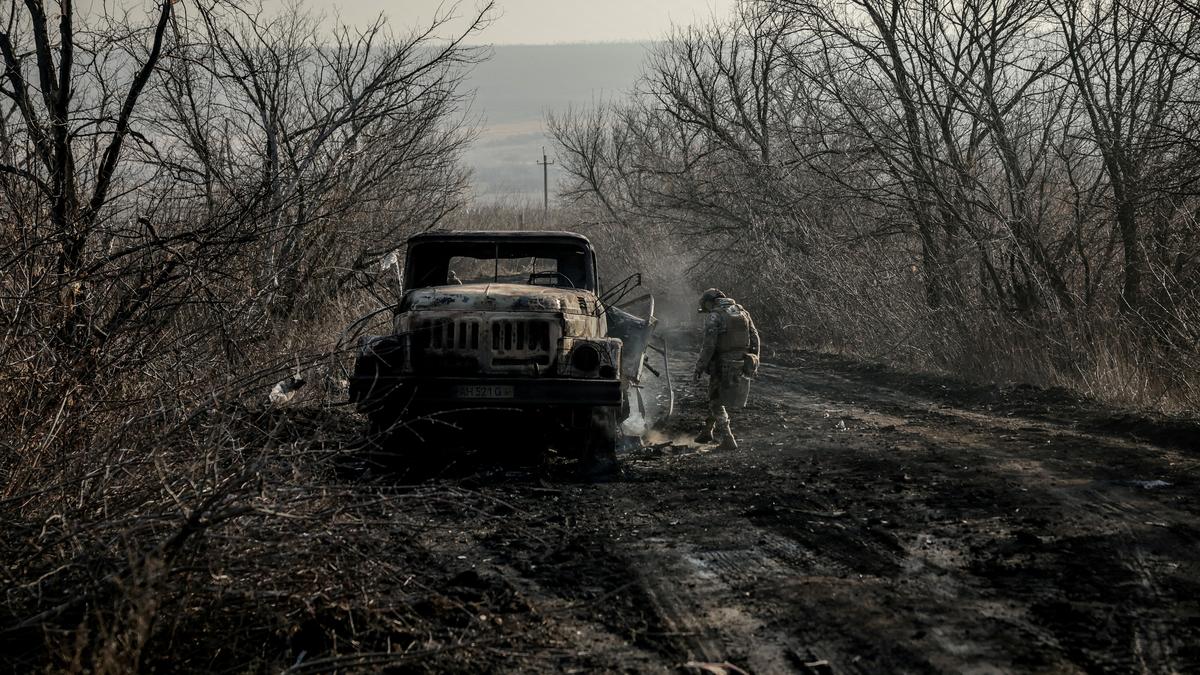
In Ukraine's war-torn eastern regions, residents navigate deadly minefields  - The Hindu


The Road 

The road is thronged with women; soldiers pass

And halt, but never see them; yet they’re here—

A patient crowd along the sodden grass,

Silent, worn out with waiting, sick with fear.

The road goes crawling up a long hillside,

All ruts and stones and sludge, and the emptied dregs

Of battle thrown in heaps. Here where they died

Are stretched big-bellied horses with stiff legs;

And dead men, bloody-fingered from the fight,

Stare up at caverned darkness winking white.

You in the bomb-scorched kilt, poor sprawling Jock,

You tottered here and fell, and stumbled on,

Half dazed for want of sleep. No dream would mock

Your reeling brain with comforts lost and gone.

You did not feel her arms about your knees,

Her blind caress, her lips upon your head:

Too tired for thoughts of home and love and ease,

The road would serve you well enough for bed.


Siegfried Sassoon, British writer was born September, 8, 1886 

Sunday, 7 September 2025

Edith Sitwell on World War II and Serhiy Zhadan’s poem about Ukraine

 I have no experience of war in my life. I have heard my grandfather and grandmother talking about the Second World War, where there was a shortage of food, and how the lights were switched off at night due to air raids. Today is the birth anniversary of Edith Sitwell British poet, who was born on September 7, 1887. She wrote the poem ‘Still Falls the Rain’ about the Blitz. 


Still falls the Rain—- 
Dark as the world of man, black as our loss—- 
Blind as the nineteen hundred and forty nails 
Upon the Cross. 

Still falls the Rain 
With a sound like the pulse of the heart that is changed to the hammer-beat 
In the Potter's Field, and the sound of the impious feet

‘Take Only What Is Most Important’, a poem by Ukrainian author Serhiy Zhadan that describes the difficult choices people must make when fleeing their homes due to war.


Take only what is most important. 
Take the letters. 
Take only what you can carry. 
Take the icons and the embroidery, take the silver, 
Take the wooden crucifix and the golden replicas. 

Take some bread, the vegetables from the garden, then leave. 
We will never return again. 
We will never see our city again. 
Take the letters, all of them, every last piece of bad news. 

We will never see our corner store again. 
We will never drink from that dry well again. 
We will never see familiar faces again. 
We are refugees. We’ll run all night. 

We will run past fields of sunflowers. 
We will run from dogs, rest with cows. 
We’ll scoop up water with our bare hands, 
sit waiting in camps, annoying the dragons of war. 

You will not return and friends will never come back. 
There will be no smoky kitchens, no usual jobs, 
There will be no dreamy lights in sleepy towns, 
no green valleys, no suburban wastelands. 

The sun will be a smudge on the window of a cheap train, 
rushing past cholera pits covered with lime. 
There will be blood on women’s heels, tired guards on borderlands covered with snow, 

a postman with empty bags shot down, 
a priest with a hapless smile hung by his ribs, 
the quiet of a cemetery, the noise of a command post, and unedited lists of the dead, 

so long that there won’t be enough time 
to check them for your own name. 

Translated from the Ukrainian by Virlana Tkacz and Wanda Phipps

Elia Kazan - A tribute


Remembering Elia Kazan, who was born  on September 7, 1909

He is known for his contributions to Hollywood and Broadway Theatre. He directed some of the well-known plays of Tennessee Williams (A Streetcar Named Desire, Cat on a Hot Tin Roof) and Arthur Miller (All My Sons and Death of a Salesman).

He is credited for introducing James Dean in the movie East of Eden (1955) and bringing out the brilliance of Marlon Brando in movies like On the Waterfront (1954), which won 8 Academy Awards, including Best Director and A Streetcar Named Desire (1951)

He won two Academy Awards for Best Director and received an honorary Oscar in 1999.